
Every garage owner eventually says some version of the same sentence: "I can fix cars, but managing people is the hard part." Technicians are the product in a garage business, their skill is what customers actually buy, and yet most workshops run on informal supervision: shouting across bays, guessing who is productive, and finding out about problems when a customer complains.
Here is a practical framework for managing garage technicians, drawn from what well-run Kenyan workshops do differently.
Assign work explicitly, not by proximity
In an unmanaged workshop, jobs go to whoever is standing nearest, and the best technician quietly accumulates the hardest work at the same pay as everyone else. Every job should be assigned to a named technician, on the record, with the approved scope attached. That one habit creates everything else: accountability, measurable output, and protection for the technician too, nobody can blame them for work they were never given.
In practice: Mech Connect assigns every job card task to a technician, so each person sees their queue and what is approved, and the owner sees who is carrying what. See the workflow →
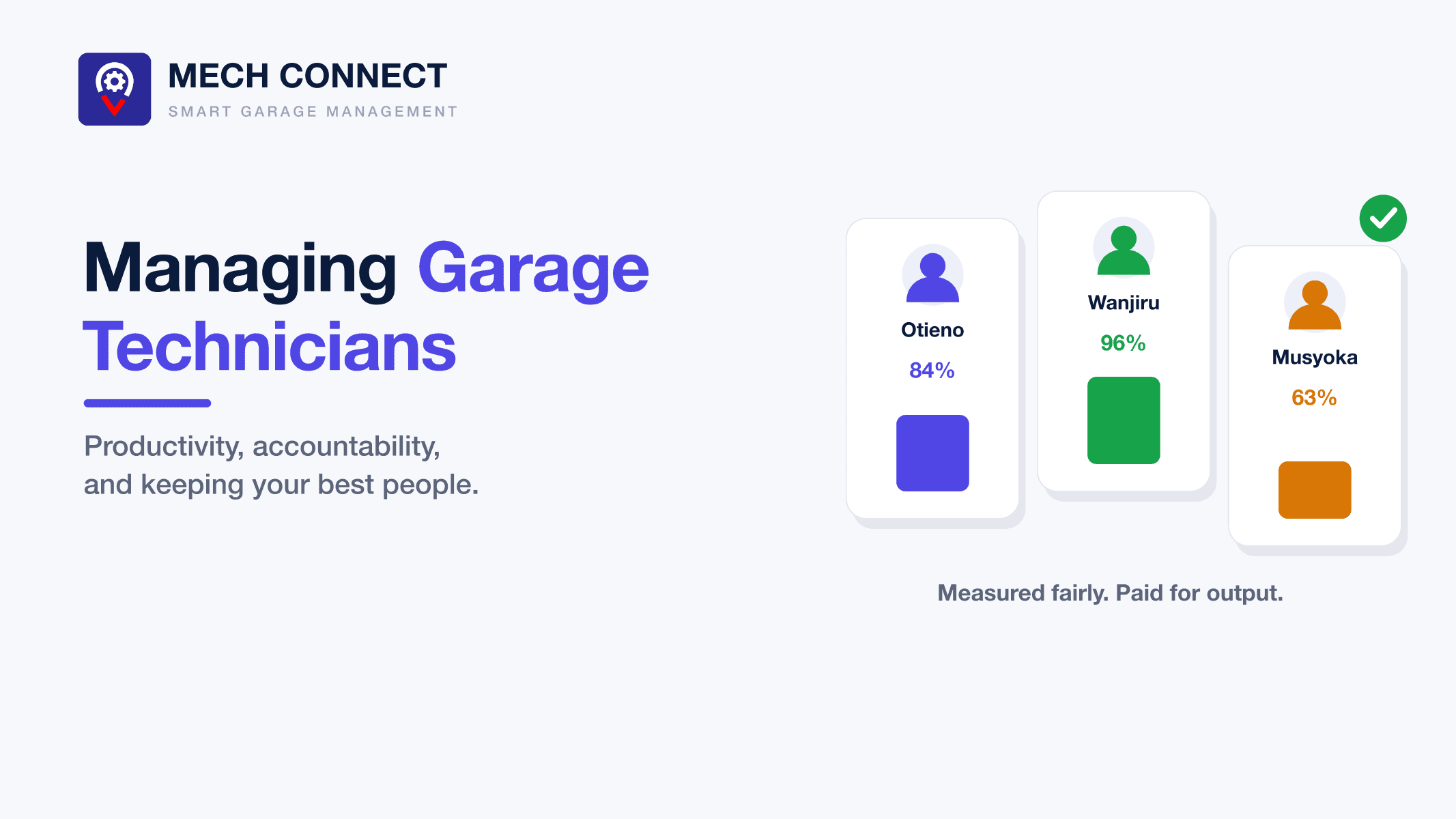
Measure productivity with data, not impressions
Ask an owner who their most productive technician is and you get an impression, usually the loudest or longest-serving. The data often disagrees. Fair measurement needs only two things recorded consistently: what jobs each technician completed, and how long they took against the estimate.
Once you have that, conversations change. "You seem slow" becomes "brake jobs take you 40% longer than the team average, what is going on?", which might reveal a training gap, a tooling problem, or that this technician gets the complicated cars precisely because they are your best. Data protects good people as often as it exposes weak ones.
In practice: technician productivity reports come out of the job cards you are already running, no extra tracking effort. See reporting →
Handle attendance like the cost it is
Late starts and unexplained absences are invisible until you price them: a technician's downtime is billable hours evaporating. Attendance tracking is not about policing, it is about making the pattern visible early enough for a fair conversation, and about rewarding the people who show up, on the record rather than in memory.
Pay in a way that rewards the behavior you want
Flat salaries are simple and fair, but they pay your fastest, most careful technician the same as your slowest. The workshops that keep their best people usually blend: a base salary for stability, plus a productivity element, a share of labour billed on completed jobs, or a bonus tied to jobs finished on time without rework. Whatever the formula, it only works when output is measured credibly. Pay schemes built on impressions breed exactly the resentment they were meant to prevent.
Why good technicians actually leave
Exit conversations across the industry repeat the same reasons, and money is rarely first:
1. Chaos. Skilled people hate rework, waiting for parts, and unclear instructions more than they hate hard work
2. Invisible effort. When nobody measures, the best performer is indistinguishable from the average one, until a competitor notices
3. No growth. No new skills, no path from technician toward supervisor or service advisor
4. Disrespect at the counter. Being blamed for scope changes and billing disputes they had no part in
Notice how many of these are process problems. A structured workshop, clear assignments, approved scopes, measured output, honest records, is not just operationally better; it is a place skilled people prefer to work. Order is a retention tool.
The owner's real job
The goal is a garage that runs the same whether you are standing in it or not, technicians who know what to do next without being told, and records that make every conversation about performance a conversation about facts. That is a system, not a personality trait.
Start with explicit assignment on every job card this week. Then book a demo to see assignment, attendance, and productivity reporting working together, or read the wider playbook on streamlining garage operations →
Ready to run a smarter garage?
See how Mech Connect puts these principles into practice for 150+ garages worldwide.