
Every garage has the stories: the customer who agreed to the price and then fought the invoice, the one who returned three weeks later claiming "it was fine before you touched it", the one who calls hourly, and the one who went straight to Google with one star and a paragraph. Difficult customers are part of the trade. Losing money, sleep, and reputation to them is optional.
The playbook below covers the four hard scenarios, and the honest truth underneath: most "difficult customer" problems are process problems wearing a customer's face.
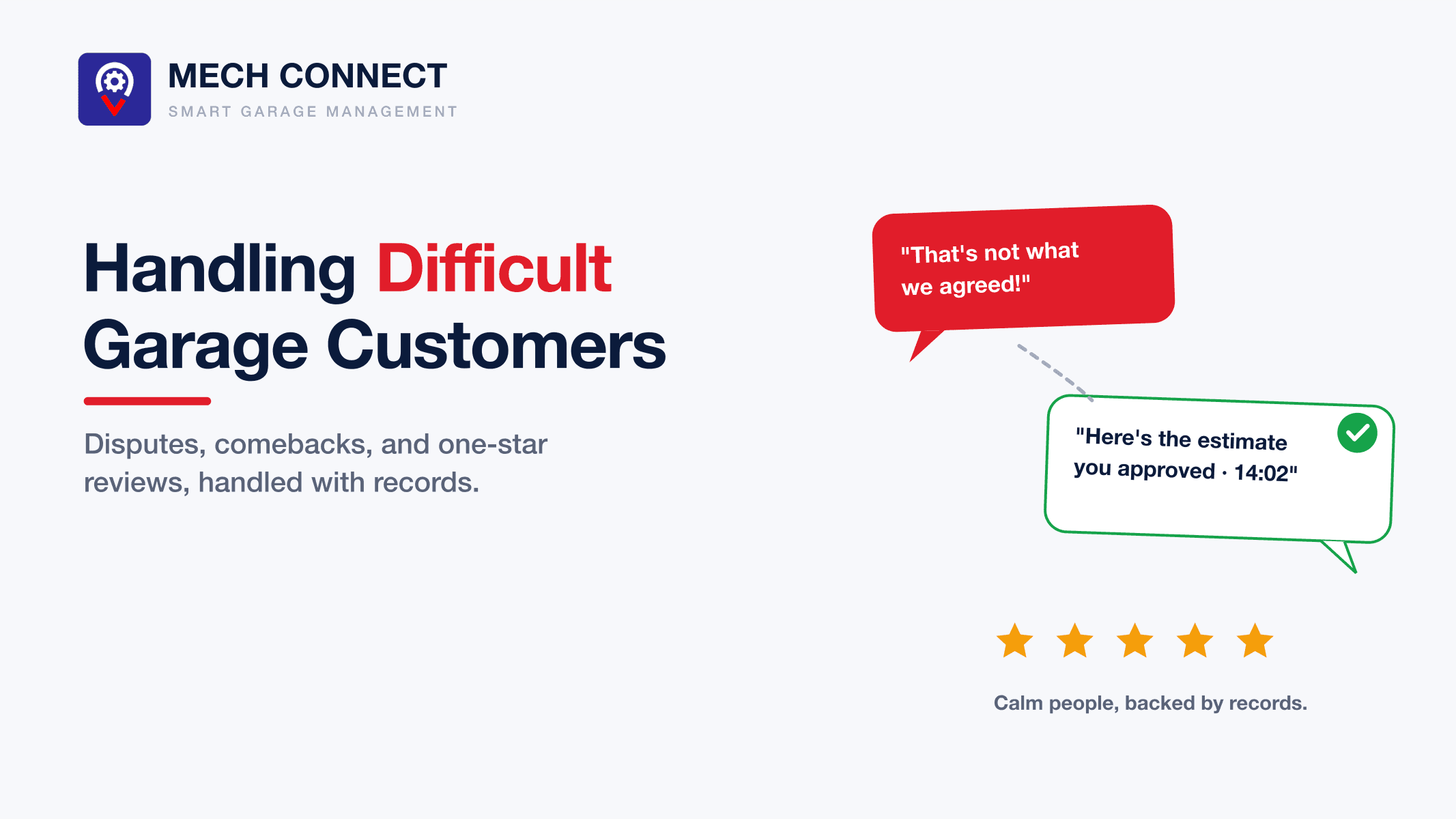
The bill dispute: "That is not what we agreed"
In the moment: stay calm, pull the record, and walk through it line by line. If a written, approved estimate exists, the conversation is short and civil, here is what you approved, here is the invoice, they match. If it does not exist, you are negotiating from memory against a motivated opponent, and you will lose something: money, the customer, or both.
The prevention: no work without a written estimate, no extra work without a fresh recorded approval, ideally approved on the customer's phone with a timestamp. Garages that enforce this watch bill disputes almost disappear, which is why it anchors our estimates guide.
The comeback: "It was fine before you touched it"
Take it seriously and inspect immediately; sometimes the comeback is legitimate, and how you handle a genuine mistake builds more loyalty than never making one. Fix real faults fast and free.
When it is not legitimate, evidence beats argument. Intake photos showing pre-existing damage, an inspection record noting the worn component the customer declined to fix, the odometer at release: these end conversations that memory-versus-memory turns into wars. A warranty policy stated on the invoice (what is covered, for how long) sets the boundary before emotions do.
The prevention: photograph at drop-off, document declined recommendations, record odometer at intake and release. Two minutes per vehicle; priceless twice a year.
The chaser: hourly calls, mounting anxiety
The customer who calls constantly is not a personality flaw walking around; they are anxiety filling an information vacuum. Every "let me check and call you back" refills it.
The prevention: updates that arrive before the customer asks. Automated SMS at each stage, booked in, diagnosed, approved, ready, removes the reason for the calls, and the live workshop board means whoever does answer gives a real answer in seconds. Garages report the phone simply going quieter.
The one-star review: public, permanent, and survivable
Respond within a day, publicly, calmly, and without lawyering: acknowledge, state your side factually and briefly, and move the resolution offline. Future customers read your reply more carefully than the complaint; a professional response to an unfair review often does more good than another five-star.
Then outnumber it. A steady stream of asked-for reviews from happy customers, the habit from our customer acquisition guide, makes any single bad review statistical noise. And when a review reveals a real process failure, fix the process and say so; "we changed how we do X" is the strongest reply there is.
When to fire a customer
Some customers are unprofitable at any price: serial disputers, abusers of staff, the ones who consume triple the service for the same shilling. Check the record, their history, disputes, margins, is in your system, and if the relationship costs more than it brings, decline the next booking politely. Protecting your team's dignity and your bay space is also customer management.
The pattern across all four scenarios is the same: calm people, backed by records. The estimates, photos, approvals, and histories that end disputes are the everyday output of a garage running on a proper system, not extra paperwork done in case of war. Book a demo to see the records that make hard conversations short.
Ready to run a smarter garage?
See how Mech Connect puts these principles into practice for 150+ garages worldwide.